


News
María José López Pourailly
 “Serious scientific collaboration, based on intensive computing, will continue being affected by the great differenced in the network infrastructures. RedCLARA represents the hope that some of these differences can be counterbalanced by activly looking for partners for the construction of optical network infrastructures, thus providing great capacity associated to reasonable costs.”
Tania Altamirano López
 |
During the event, academics from Chile will address topics that include the security of information, personal data, the importance of the preservation of information backup and data scheme specially protected by the universities.
María José López Pourailly
 “RedCLARA has created development needs in countries that didn’t have them before, and in those countries that already had those needs, it has contributed to the consolidation of their operations. This is highly important, because a country needs to generate its own science and technology in order to boost its own development”.
Tania Altamirano López
 This publication represents the situation of the 13 networks connected to RedCLARA. You can download the Spanish version in PDF format by clicking HERE.
Tania Altamirano López
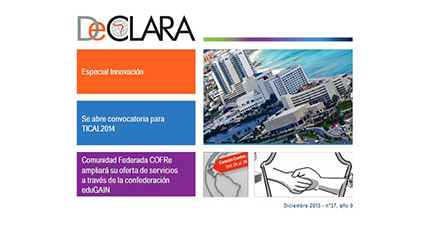 In the current edition we highlight: Prepare your luggage for next May ... Destination: Cancun! The call for papers for TICAL2014 is now open, Special Edition: Innovation, ELCIRA participates in outstanding international events and Federated Community COFRe will expand its range of services through the eduGAIN confederation.
Comisión Europea
The European Commission has for the first time presented calls for projects under Horizon 2020, the European Union's €80 billion research and innovation programme.
 Worth more than €15 billion over the first two years, the funding is intended to help boost Europe's knowledge-driven economy, and tackle issues that will make a difference in people's lives. This includes 12 areas that will be a focus for action in 2014/2015, including topics such as personalised healthcare, digital security and smart cities.
More information: http://ec.europa.eu/digital-agenda/en/news/horizon-2020-launched-%E2%82%AC15-billion-over-first-two-years